


GLOW Peptide Blend: What Is Actually in It, What the Research Says About Each Part, and What Changed in July 2026
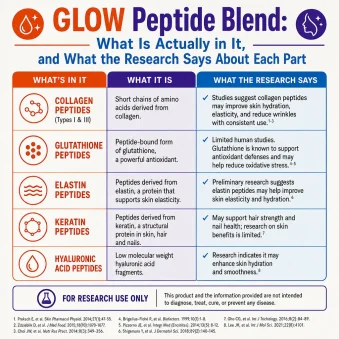
There is no study of the GLOW blend. Not one. What exists is fifty years of published work on GHK-Cu, a large body of rodent data on BPC-157, and a thymosin beta-4 literature complicated by the fact that two different molecules are sold under the same abbreviation. On top of that, the regulatory position of two of the three components moved this summer. This reference works through each part separately, because that is the only honest way to do it.
Research-use-only disclaimer: GLOW blend supplied as a research chemical is intended strictly for in-vitro and laboratory research use and is not intended for human or veterinary use in that context. Findings below come from cell culture and animal models unless stated otherwise. No dosing or administration guidance appears anywhere in this article, and nothing here is medical advice.

TL;DR
GLOW is BPC-157, TB-500 and GHK-Cu in one vial. No published study has tested those three together, so every synergy claim you read is inference. Of the three, GHK-Cu has the strongest evidence: isolated from human plasma in the early 1970s, and reported in the 2018 Pickart and Margolina review to modulate 4,048 human genes, roughly 6% of the genome. BPC-157 has a large rodent literature and very little human data. TB-500 is two different molecules sharing a name, and every completed clinical trial of thymosin beta-4 used the full-length protein rather than the fragment. On 23 to 24 July 2026 the FDA's Pharmacy Compounding Advisory Committee voted to recommend BPC-157, KPV, TB-500, MOTS-c, Semax and Epitalon for the 503A affirmative list, and rejected DSIP. Those votes are advisory and rulemaking has not completed. Research use only.
Composition: BPC-157, TB-500, GHK-Cu. PrymaLab supplies 50mg and 70mg formats.
Blend-level studies: zero.
Strongest component evidence: GHK-Cu. Isolated early 1970s, 4,048 genes modulated per the 2018 IJMS review, plasma levels down roughly 60% by age 60.
Weakest human evidence: BPC-157. Extensive rodent data, minimal human data, and the rodent work is concentrated in a small number of connected groups.
Naming trap: TB-500 refers to at least two different molecules, and neither is what the completed clinical trials used.
Regulatory: BPC-157 off Category 2 since April 2026. PCAC recommended six peptides for the 503A list on 23 to 24 July 2026. Not binding, not yet law.
Status: preclinical. Research use only.
What Is in the Vial
GLOW is three compounds combined in a single preparation. PrymaLab supplies it at 50mg and 70mg total peptide content, and as a preloaded autoinjector at 50mg/ml.
| Component | What it is | Approx. mass |
|---|---|---|
| GHK-Cu | Glycyl-histidyl-lysine tripeptide bound to copper(II) | ~340 Da peptide, ~403 Da complex |
| BPC-157 | 15-residue partial sequence (GEPPPGKPADDAGLV) from a gastric juice protein | ~1,419 Da |
| TB-500 | Fragment of thymosin beta-4. Sources disagree on 7 or 17 residues | ~889 Da (7-mer) up to ~4,963 Da (full protein) |
Three molecules, three orders of magnitude of published evidence between them, and a mass range spanning a factor of more than five depending on which TB-500 you have. That spread is the reason this article is organised by component rather than by claimed benefit.
The Regulatory Position Moved in 2026
Anything written about this blend before July 2026 is now partly out of date, including the earlier version of this page. Two of the three components were directly affected.
BPC-157 came off Category 2
On 29 September 2023 the FDA added BPC-157 to Category 2 of the interim 503A bulk drug substances list.[1] Category 2 covers substances the agency has flagged as presenting significant safety risk or lacking sufficient characterisation, and inclusion prohibits use in traditional pharmacy compounding. The stated rationale was not a specific adverse event. It was potential immunogenicity for certain routes of administration, plus difficulty characterising peptide-related impurities and the active ingredient itself.[1]
That distinction matters and it is routinely misreported. Category 2 placement was an assessment of insufficient information, not a finding of harm.
In April 2026 the FDA removed BPC-157 from Category 2.[2] Removal is not approval, and it did not automatically place the compound on the affirmative 503A list. It moved BPC-157 from prohibited back to unresolved.
The July 2026 PCAC vote
On 23 and 24 July 2026 the Pharmacy Compounding Advisory Committee reviewed seven peptides and voted on whether to recommend each for the 503A affirmative list.[3] The results were close on every single one.
| Compound | Vote | Outcome |
|---|---|---|
| BPC-157 | 8 to 6, one abstention | Recommended |
| KPV | 8 to 6, one abstention | Recommended |
| TB-500 | 8 to 6, one abstention | Recommended |
| MOTS-c | 7 to 5, two abstentions | Recommended |
| Semax | 8 to 5, one abstention | Recommended |
| Epitalon | 7 to 5, one abstention | Recommended |
| DSIP (emideltide) | 6 to 7, one abstention | Rejected |
Two of the three GLOW components appear on that list. BPC-157 and TB-500 both passed 8 to 6. GHK-Cu was not part of this review.
Three things about those votes are worth holding onto. First, they are advisory and not binding on the FDA.[3] Second, none of these six is legal to compound today. Rulemaking has to run first, and the HHS Secretary must formally approve any addition to the 503A list.[3] Third, an 8 to 6 vote with an abstention is not an endorsement. It is a committee that could not reach consensus, deciding narrowly in favour.
The rejection of DSIP is the most informative data point in the table. Six of the seven cleared a committee that was clearly divided, and one did not. That tells you the committee was discriminating between compounds rather than approving a category.
Why There Is No GLOW Research
GLOW is a supplier-created combination. It was not developed in a laboratory, tested in a model, or written up. No study has given an animal or a cell line all three of these compounds together and compared the result against the components individually.
That is the standard situation for peptide blends and it deserves saying plainly, because the word "synergistic" appears on nearly every page selling this product, including ours until this rewrite.
Synergy is a specific technical claim. It means the combined effect exceeds the sum of the individual effects, and demonstrating it requires a study design that includes the individual arms. Without those arms you cannot distinguish synergy from addition, and you cannot distinguish either from one component doing all the work while the other two ride along.
What can honestly be said: three compounds with separate literatures pointing in a broadly similar direction, combined in one vial, which saves handling three. That is a convenience argument rather than a pharmacology argument. I would rather make the small true claim than the large unsupported one, and I think the sites making the large claim are going to have a harder time as answer engines get better at checking sources.
GHK-Cu, the Part With Real History
This is the component I find genuinely interesting, and it is the one most marketing copy skips in favour of the two peptides with better name recognition among people who lift weights.
Discovery, and the observation that started it
GHK was isolated from human plasma in the early 1970s by Loren Pickart, who was investigating why plasma from young donors behaved differently from plasma from older donors in liver cell cultures.[4] Old-donor plasma did not support the same regenerative behaviour. Something present in young plasma and depleted in old plasma was responsible, and the tripeptide glycyl-histidyl-lysine turned out to be a large part of it.
The tripeptide binds copper(II) with high affinity, and the copper complex is the active species in most published work. That is why the compound is written GHK-Cu rather than GHK, and it is why a GHK preparation without copper is not the same material.
The age curve
Plasma GHK declines with age by roughly 60 percent between the twenties and age 60.[4] A molecule that falls that far across adult life, and which turns out to influence tissue remodelling genes, was always going to attract attention whether or not every downstream claim survives scrutiny.
I would flag one thing about how this figure gets used. A 60 percent decline is an observation about correlation with age. It is not by itself evidence that restoring the molecule reverses anything age-related. Plenty of things decline with age without being causes of ageing, and the leap from "declines" to "therefore supplementing helps" is made constantly in this space with no supporting work.
The gene expression finding, and how to read it
The number that gets quoted most often comes from the 2018 Pickart and Margolina review in International Journal of Molecular Sciences: GHK modulates the expression of 4,048 human genes, roughly 6 percent of the human genome.[4]
That figure is real and it is impressive on its face. It also needs reading carefully, and almost nobody quoting it does.
A compound that shifts four thousand transcripts is not demonstrating precision. It may be demonstrating the opposite. Broad transcriptomic effects are consistent with a signalling molecule with wide reach, and they are equally consistent with a compound producing a general cellular stress or metabolic response that cascades. Copper itself is redox-active and a cofactor for many enzymes, so some fraction of that signal is plausibly copper doing copper things rather than the tripeptide doing anything specific.
The direction of the changes is what matters more than the count, and the reported pattern skews toward tissue remodelling and repair programmes.[4] That is a more useful claim than the headline number, and it is the one worth building on.
What the functional work covers
Across cell and animal studies, GHK-Cu has been reported to affect collagen synthesis, decorin production, glycosaminoglycan synthesis, angiogenesis, and the behaviour of fibroblasts in wound models.[4] Decorin is worth singling out because it is a small proteoglycan that regulates collagen fibril assembly, and effects there speak to matrix organisation rather than raw collagen quantity. Making more collagen and making better-organised collagen are different outcomes, and the second is the one that matters for tissue quality.
The commercial validation nobody mentions
GHK-Cu has been used in cosmetic formulation for decades. That is not a scientific endorsement, but it does mean stability, handling and topical tolerability have been worked out repeatedly by companies with regulatory obligations and product liability exposure. Neither BPC-157 nor TB-500 can say the same. When someone asks me which part of GLOW I would be least worried about from a formulation standpoint, this is the answer, and it is not close.
BPC-157, and the Gap Between Reputation and Data
BPC-157 is a 15-residue partial sequence of a protein found in human gastric juice. The sequence is GEPPPGKPADDAGLV. It is the most discussed compound in this blend and it has the widest gap between how confidently people talk about it and what has actually been shown in humans.
What the rodent literature covers
The animal literature is large and spans tendon, ligament, muscle, gut and vascular injury models.[5] Reported effects include accelerated healing rates, improved tensile properties in tendon models, and protective effects in gastrointestinal injury models. Taken at face value it is a striking body of work.
The complication is who produced it. A substantial proportion traces back to a small set of connected research groups, much of it centred in Croatia.[5] That concentration does not make the findings wrong. It does mean the effective number of independent replications is considerably lower than the raw citation count suggests, and independent replication is the thing that separates a real effect from a laboratory artefact.
What is missing
Human efficacy data. As of this writing I am not aware of a completed, published, controlled human trial establishing efficacy for any indication. The 2023 Category 2 rationale spoke to exactly this: insufficient characterisation and unresolved immunogenicity questions rather than demonstrated harm.[1]
The July 2026 PCAC vote of 8 to 6 with an abstention reflects the same tension.[3] A committee reviewing the full dossier split almost evenly. That is what genuine uncertainty looks like when it is written down.
TB-500, and the Molecule That Was Never in the Trials
This section contains the single most useful thing in this article, and it took me a while to work out because the published sources genuinely conflict with each other.
The naming problem
Thymosin beta-4 is a 43-residue endogenous protein of roughly 4,963 Da whose main known function is sequestering monomeric G-actin.[6] TB-500 is described as a synthetic fragment of it. Beyond that point the sources diverge. Some describe TB-500 as the seven-residue Ac-LKKTETQ actin-binding sequence corresponding to residues 17 to 23, roughly 889 Da. Others describe it as a seventeen-residue fragment.[6]
I have not been able to resolve that discrepancy from published sources, and I am not going to pretend otherwise. What I can say with confidence is that the actin-binding motif itself is LKKTETQ, that material sold as TB-500 is a fragment rather than the full protein, and that the mass difference between the candidate interpretations is large enough to matter for stability, solubility and analytical confirmation.
The part that matters most
Here is the detail that changes how you should read every clinical claim made about TB-500.
Every completed clinical trial of thymosin beta-4 used the full-length 43-residue protein, not the fragment.[6] The RegeneRx RGN-259 programme, a 0.1% thymosin beta-4 ophthalmic formulation, completed Phase III trials and holds orphan drug designation for neurotrophic keratopathy, without marketing approval.[6] The cardiac work is the same. Full-length protein throughout.
So when a page selling TB-500 cites clinical trial evidence, it is citing evidence for a different molecule. The fragment has no completed human efficacy trials.[6]
That is not a subtle distinction. It is the difference between "this compound has been through Phase III" and "a larger protein containing part of this compound's sequence has been through Phase III." Those support very different claims, and I have not seen a single competitor page draw the line.
If you are comparing suppliers, sequence confirmation on the certificate of analysis is the only thing that settles what is in the vial. Our TB-500 reference material listings state the sequence supplied.
The Copper Chemistry Question Nobody Asks
I have never seen this addressed on a page selling a GHK-Cu blend, and it is a reasonable thing to think about before you combine a redox-active metal complex with other peptides in a single vial.
Copper catalyses oxidation of methionine and cysteine residues. So the sensible question is whether the co-formulated peptides contain either residue.
Working through the sequences:
- BPC-157 is GEPPPGKPADDAGLV. Glycine, glutamate, proline, lysine, alanine, aspartate, leucine, valine. No cysteine, no methionine.
- Ac-LKKTETQ, the actin-binding fragment, is leucine, lysine, lysine, threonine, glutamate, threonine, glutamine. No cysteine, no methionine.
- Full-length thymosin beta-4 contains a methionine near the N-terminus.
A GLOW built on the short fragment therefore has no obvious oxidation target for the copper to attack. A GLOW built on full-length thymosin beta-4 has one.
Whether that matters in practice depends on concentration, buffer composition, pH, oxygen exposure and storage duration, and I have not found it studied for this specific combination. It is a formulation question worth putting to any supplier, and it is a second reason the TB-500 ambiguity is more than a labelling quibble. The molecule you have determines whether this is a non-issue or something to ask about.
Where the Evidence Actually Sits
| Component | Evidence depth | Main limitation | 2026 regulatory |
|---|---|---|---|
| GHK-Cu | Strongest. Isolated early 1970s, 4,048 genes modulated, decades of cell and animal work, plus cosmetic-industry formulation history | Broad transcriptomic findings are easy to over-interpret. Correlation with age is not evidence of causal reversal | Not part of the PCAC review |
| BPC-157 | Large rodent literature across several injury models. Minimal human data | Concentrated in a small number of connected groups. No completed controlled human efficacy trial | Off Category 2 April 2026. PCAC recommended 8 to 6 on 23 July 2026 |
| TB-500 | Moderate, but the human trial evidence belongs to the full-length protein | Sequence ambiguity. No completed human efficacy trial of the fragment itself | PCAC recommended 8 to 6 on 23 July 2026 |
| The blend | None | No study has combined them | n/a |
What Research Has Not Established
No study has tested these three compounds together in any model. No completed controlled human trial supports efficacy claims for BPC-157. No completed human efficacy trial exists for the TB-500 fragment as distinct from full-length thymosin beta-4. No published work addresses whether copper in the vial affects the stability of a full-length thymosin beta-4 preparation over storage.
Beyond that, and less often acknowledged: nothing in the GHK-Cu literature, which is the deepest of the three by a wide margin, was generated with the other two compounds present. Fifty years of GHK-Cu work tells you about GHK-Cu. It does not transfer to a mixture.
What is reasonably well established is narrower and worth stating clearly. GHK-Cu influences collagen and matrix protein synthesis in fibroblast models and modulates a large number of genes with a repair-associated skew. BPC-157 accelerates healing in several rodent injury models. Thymosin beta-4 sequesters G-actin and has completed Phase III ophthalmic trials without approval. Those are three separate facts about three separate molecules, and assembling them into a claim about a blend is something the reader does, not something the literature does.
How Research-Grade GLOW Is Characterised
A three-component blend needs each component confirmed individually, not a single total-mass figure. Reversed-phase HPLC separates the three and yields purity per peak. Mass spectrometry confirms identity, and for the TB-500 component it is the only method that settles which molecule is actually present. Copper content should be confirmed separately, since the tripeptide and its copper complex are not the same material and the peptide alone is not what the literature describes.
At PrymaLab, research peptides are characterised with HPLC and mass spectrometry verification and independent third-party testing. No lot-specific figures are asserted in this general reference; see the certificate of analysis linked from each product listing.
Frequently Asked Questions
What is in the GLOW peptide blend?
BPC-157, TB-500 and GHK-Cu in one vial. BPC-157 is a 15-residue gastric-juice-derived sequence, TB-500 is a fragment of thymosin beta-4, and GHK-Cu is a copper-bound tripeptide.
Is there any research on the GLOW blend itself?
No. No published study has administered these three together. Blend-level claims are extrapolated from three separate component literatures of very unequal quality.
Which component has the strongest evidence?
GHK-Cu, by a wide margin. Isolated from human plasma in the early 1970s, with the 2018 Pickart and Margolina review reporting 4,048 human genes modulated, about 6% of the genome.
Did the FDA ban BPC-157?
It was placed on 503A interim Category 2 on 29 September 2023 over immunogenicity and characterisation concerns, then removed from Category 2 in April 2026. PCAC voted 8 to 6 on 23 July 2026 to recommend it for the affirmative list. That vote is advisory and rulemaking has not completed.
What did the July 2026 PCAC vote cover?
Seven peptides. BPC-157, KPV and TB-500 each passed 8 to 6 with one abstention. MOTS-c passed 7 to 5 with two abstentions. Semax passed 8 to 5 and Epitalon 7 to 5. DSIP was rejected 6 to 7. None is legal to compound today.
Does the copper affect the other peptides?
Copper catalyses oxidation of methionine and cysteine. BPC-157 and the Ac-LKKTETQ fragment contain neither. Full-length thymosin beta-4 contains a methionine, so a blend built on the full-length protein carries a target that a fragment-based blend does not.
What does TB-500 actually mean?
Sources conflict on whether it is a seven-residue or seventeen-residue fragment. What is clear is that it is a fragment, and that every completed thymosin beta-4 clinical trial used the full-length 43-residue protein instead.
Is GLOW blend approved for human use?
No. It is laboratory reference material for research use only. None of the three components is FDA-approved for any indication.
References
- US FDA. Interim policy on bulk drug substances nominated for use in compounding under section 503A, Category 2 listing including BPC-157, effective 29 September 2023.
- US FDA removal of certain peptide bulk drug substances from Category 2 of the interim 503A bulks list, April 2026.
- Pharmacy Compounding Advisory Committee meeting, 23 to 24 July 2026. Vote outcomes for BPC-157, KPV, TB-500, MOTS-c, Semax, Epitalon and emideltide (DSIP). FDA meeting materials
- Pickart L, Margolina A. Regenerative and protective actions of the GHK-Cu peptide in the light of the new gene data. International Journal of Molecular Sciences. 2018.
- Sikiric P, et al. Reviews of BPC-157 in rodent injury models.
- Thymosin beta-4 and TB-500 in tissue healing, regeneration and musculoskeletal repair: a scoping review. Applied Sciences. 2026;16(12):6202. MDPI
Molecular masses are nominal average values, rounded, given for size comparison rather than as analytical specifications. Lot mass is confirmed by mass spectrometry on the certificate of analysis. Regulatory status described here is current as of 8 August 2026 and is subject to change; verify against FDA sources before relying on it.
Final disclaimer: This article is an educational research reference. GLOW blend is sold and studied for laboratory research use only and is not approved by any regulatory authority for human or veterinary use. Statements have not been evaluated by the FDA. Nothing here is medical advice, administration guidance, or a treatment claim.
Descriptions of component activity come from cell and animal models and may not generalise. Regulatory information is summarised from public FDA materials and secondary reporting and should be verified independently. Always confirm the legal status of any research compound in your jurisdiction before purchase or use.